• Skip to primary navigation
  • Skip to main content

MelvinBlog

A blog that chronicles my journey on online marketing, blogging, social media, technology and life.

  • Author
  • Photos
  • Contact

Blogging Tips

What is Problogging & A Look at Some Pro Bloggers

by Melvin · Jan 29, 2010

Problogging is a word that’s not new. If it sounds new to you, then probably you are living under the cave. Pro blogging simply stands for professional blogging and today I would like to talk about it more from my own perspective. No worries as I’ll assure you that this is no generic article.

Each and everyone of us bloggers want to be called as professional bloggers but in reality we’re not. Professional bloggers are simply the ones who do blogging as a business, more specifically as a primary business. They usually allot 6+ hours per day with their blogs, mostly dealing with content and marketing. That being said even though I am spending a lot of time blogging, I cannot still call myself as a problogger because I am student.

It’s also a big misconception that you can look like a professional one by blogging with perfect grammar and great fluency. Again its a total misconception. Although I don’t want to imply the mentality of speaking like a moron/douchebag, you cannot just focus too much on how formal your way of speaking is. At the end it’s all about gaining popularity and capitalizing on it, not boasting your English degree.

So Im going to take a look at some probloggers today. Obviously, just earning a big amount of money doesn’t mean you’re a pro blogger. Anyhow, here are the great examples of bloggers who do professional blogging.

  • Darren Rowse – is the pioneer of professional blogging. I probably have never seen a guy who is as dedicated as Darren in this world. He blogs at ProBlogger.com and some other many sites. What’s amazing with this guy is that you can take a look at all his blogs and easily notice that they are all established in whatever niche they are. Although he’s a bit conservative in terms of making money, I still believe he makes a heck of cash with all of his assets in the internet
  • Yaro Starak – Yaro is my favorite blogger. Although he’s not the earliest person to do blogging, he probably is the first guy to leverage his audience best by offering a membership site called Blog Mastermind. Since then it really exploded his expertise on the subject matter where he gained a lot of reputation and trust. Look at Yaro as a blogger who got interested in internet marketing, studied it and mixed it with blogging superbly to achieve who he is today now.
  • John Chow – Ok it took me 5 minutes to decide whether I should include Chow in this list. After all he’s like Shoemoney. The only difference though is that Chow has no other big  business aside from blogging w/c is why he’s in this list. John is the best example of a pro blogger who doesn’t need to have perfect way of expressing things in word.
  • David Risley – It was only last year when I stumbled upon him and his blog. Some of you may not even know him yet. If not it’s your best chance to know him @ DavidRisley.com. He connects with his readers well by just blogging spontaneously. David is a problogger even before the term existed but he just started building his expertise couple of years back. If you’re looking to build a blogging business, then head on and grab his six figure blogger blueprint (Don’t just get afraid of his large voice!)

Okie dokie. As always I’d love to hear your opinions on this and your thoughts about problogging. Also do you have any other suggestions out there for professional bloggers? Or do you think someone in that list doesn’t deserve being included?

Filed Under: Blogging Experience, Blogging Tips, Featured Articles, Internet Marketing, Preachings, Ramblings, Social Media Tagged With: pro bloggers, problogging

Demand & Supply – Understanding Blogging Economy

by Melvin · Jan 23, 2010

Currently Blogging is one of the greatest Internet Marketing Model. While many people use blogging for personal purposes, some use it as an Internet Marketing tool. The few people who use blogging as Internet Marketing tool are the ones who want to earn money, reputation and fame. But only a very few percentage of them succeed.

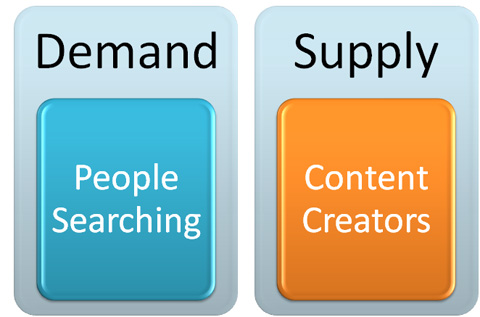
One of the reason of success of these successful bloggers (whom we call pro bloggers) is the understanding of Blogging Economy. The understand how to utilize their resources, where to invest and how to balance Demand and Supply. Demand and Supply is core of any kind of Economy. The relationship between demand and Supply underlines the forces behind the allocation of your blogging resources in the most efficient ways. It also decides the price (may not be a monetary value) of your content in the Blogging Community.

Before we proceed any further let us define Demand and Supply.

Demand refers to how much (quantity) of a product or service is desired by consumer. The quantity demanded is the amount of a product people are willing to buy at a certain price.

Supply represents how much the market/producer can offer. The quantity supplied refers to the amount of a certain good producers are willing to supply when receiving a certain price.

How does Demand and Supply work for Blogging?

In blogging, a blogger is not always selling. So two cases arises, one when a blogger is selling his content (posting article/post) for free and other when a blogger is selling a product or service for a price.

CASE I: Blogger provides free information through an article/blog post

Here the commodity (information) is free to everyone, so money is not a factor. When something is free, it means the supply is theoretically infinite. The demand of the content decrease and so does its value. Now to increase the value of your content, we need to increase the demand. And since our commodity is free, its not that simple. There are two different ways to increase the demand.

  • First is decreasing the supply. But practically it is not possible to just decrease the supply. In case of a blog post once posted is available to everyone. One way to decrease the supply will be to password protect the whole/part of post. You may also consider having a free members area where selected few have access to the content. This way you virtually decrease the supply. This will only work if your content had high demand before.
  • Second is allocation of resources. Allocation of resources in blogging means investing more time (if required money) to research the topic you are about to write. Write the post in a unique way or better with a whole new perspective.

CASE II: Blogger is selling some product or service

Here the commodity is not free and those who want it or need it have to pay some price. When you are selling something, the price is decided by the demand and supply in the market (here blogging community).

When money is involved, it becomes easier to understand the market. Price decreases with higher supply and increases with increase in demand. So if the product/service you are selling is available elsewhere in plenty (may be lower price) you will have to decrease your price too. But if the demand is high and supply is low (only a few more sellers are there), you can increase the price as well.

There are some more factors which decide the price as well. One of these factor is customer awareness. Think of the condition when a certain product eg. Blogging Guide is available in plenty but the customer is aware of only your guide. The customer will buy yours. You can set higher price. This is a case of Virtual Demand (a imaginary high demand and low supply condition).

Whatever I have mentioned above are only few of the theories of Demand and Supply in Blogging. To succeed you need to understand them and apply these theory practically. For example, I told you about how demand and supply control the price. You can use it to decide the at what price you should sell your product/service, so that people buy it. How to make them buy your product and service at a ceratin price.

If you have any questions, just leave a comment and I will answer them.

PS: The most important thing to note about Demand and Supply is that how impractical (it is mostly theory) it may seem, it governs the market. You can think of cases where the theory may not apply, but in most cases Demand and Supply theory works with a high efficiency.

Editor of Agent Deepak – A student at IIT, Kharagpur. He has 3 years of experience in Blogging and also have 1 year experience in SEO, Graphics design and Web design. He is tweeting @AgentDeepak. If you are on Facebook you can also befriend him @AgentDeepak

Photo Credit from Chief Ingredient

Filed Under: Blogging Tips, Guest Post, Internet Marketing, Traffic Tagged With: blogging economy, demand and supply, Internet Marketing

Your Guest Post was Rejected, What’s Next?

by Melvin · Jan 20, 2010

By now you probably already have learned that guest posting is a powerful way to drive crazy high quality traffic to your site. I’m not just talking about the hits here, I’m talking about traffic that could easily become one of your subscribers, more importantly your customers. Guest Posting really is going to do the job for your blog in terms of getting more publicity.

So because a lot of people already knew it and learned it’s benefits, it seems that every blogger in every corner is sitting, focusing and writing a guest post for the big blogs in their niche. But the question is, are they getting success by actually getting their post/s qualified? Or is it the owner of the other blog think their guest post suck?

Ok I will talk from experience here. Probably you have seen me and my blog on some other blogs having a guest post so it’s pretty obvious guest posting is my blog project since late last year. But I am going to confess that for every 5 guest posts I write, less than 50% gets accepted. For every 10, it’s just 4 and yeah it’s painful especially thinking about the time I spent writing and writing only for the author to say it has not met the qualifications. *sucks*

So that was my experience early this year when I was just totally new to guest posting. Obviously I have improved a lot but the question is what to do next when you get rejected? (ok, no list in this post guys!)

The answer is just keep on going. I know other people would say try to analyze, learn and improve but I think it’s just all about keeping on writing. I’d tell you’d be surprised on how just writing alone could unknowingly improve your way of writing. I love reading my old posts and it always amazes me how many stupid mistakes I have done before even though I (think) have a good english grammar (for someone who lives outside the US).

It’s ok to feel bad but that should never keep you from trying. Bloggers have different styles, so they also have different requirements, different take on whether the article is good or crap. If you’re guest posts got rejected then go ahead and submit it others. If its still discarded then don’t delete it from your hard drive. Even if it piles up there it’s still going to do you wonder by letting you become a better writer.

What do you think guys? I would really love to get your opinion about this topic.


Filed Under: Blogging Experience, Blogging Tips, Guest Post, Preachings, Social Media, Top Posts, Traffic Tagged With: guest posting, guest posts

The Big Glitch In Guest Posting

by Melvin · Jan 11, 2010

By now you probably have been already told that the quickest way for a brand new blog to get traffic and build some buzz is by doing guest posting. It doesn’t just apply to new blogs, it also applies to mid cap blogs like my blog and probably your blog. To sum it up, doing guest posts is vital in increasing your blog’s brand awareness.

Anyways, I’m always a good observant when it comes to the blogosphere and all the things that are currently happening in it. And one thing I noticed is that there is “somehow” a big glitch in guest posting (glitch means minor problem, adding the word big means it’s a big problem, lols!).

It usually happens like this. A famous blogger is entering a busy weekend thus no time for blogging. Then he would offer his readers to guest post. Lastly he would publish the said post. Where’s the problem? Well if you observe it’s not hard to figure out that the certain guest post SUCKS! In formal terms, it doesn’t meet the quality that the owner usually publishes. What the heck? How is that possible?

This is debatable and many will not agree with me. That happens simply because of the fact that the owner blogger is busy. When someone submits a guest article, the owner doesn’t really read it, he just skims at it! He just looks at the basic things, the grammar, spelling, if the sentence makes sense, if the paragraph is well done and etc. They don’t really analyze that much if it’s a generic boring article or a regurgitated concept. In the end they think like it’s better to post something than have nothing for your readers right? Wrong!

This is obviously a big glitch. It harms both blogs. No one will click on the link of the guest poster because the blog post sucks and on the other hand, the loyal readers of the famous blog would feel bad that the quality they used to see is not met. And worse, they might start lose your trust if you do it again and again. Reputation tarnished!

Guest posting is good, cool and nice. You reap both benefits. But if done like the way I mentioned above, it becomes a recipe for failure. This is my call both to guest posters and the blog owners. Be sure to do it right.

Filed Under: Blogging Experience, Blogging Tips, Internet Marketing, Preachings, Ramblings Tagged With: guest post flaw, guest posting glitch

Do You Know You’re a Boring Blogger?

by Melvin · Jan 5, 2010

The number 1 advice people always say to you to succeed in blogging is that you need to create good and high quality content. So there ya go! Because of it you’re forced to write articles like a freelancer, you’re fed into acting like you need to be like Darren Rowse and stuffs. The end result, you become a boring blogger.

Most people get it wrong by thinking that writing top-notch content is all about the perfectness of the grammar, the formality of how words are written and just sounding absolutely professional. Believe me it’s not! The problem with most bloggers is that they try to be perfect and because of that, they sound like a robot. It’s just like reading an article in a monotonous tone. Try reading books in your school library and you’ll know what I mean.

Ironically sometimes, you don’t realize that you’re starting to bore your readers to death. Results? A decline from just about everything (readers, subscribers, traffic , etc). Anyways here I compiled a list why you might be or starting to become a boring blogger:

  • You sound like a lawyer – and you don’t need to. I don’t know but professional blogging for me is not really about being professional words-wise or with the proper grammar and stuffs. Pro Blogging is about treating blogging as a serious business. So if you’re a 15 year old kid who’s trying to sound like your teacher, then you’re not helping your blog.
  • Generic Articles – generic articles is a really big NO NO. Or at least minimize it. Generic articles is like the ones that has been tackled 300 million of times and you still tackled it and talked it in a none unique way. Articles like “how to earn money from blogging” or “Make Money By starting a blog”. You see, it’s hard not to regurgitate a topic. But you make it unique from the rest by adding something unique and breaking it down to more specific topics.
  • Transformed into a  news site – Blogs like TechCrunch can certainly do this considering the audience that they have right now but smaller bloggers SHOULD NOT. I see a lot of bloggers just writing the same news on their blogs w/c really adds 0 value. Just because Dennis Yu is popular,  does it mean you have to write about him too?
  • All Promotional stuffs – I guess we can blame a guy named John Chow for this? lols. It turns me off so much when I see someone promotes a product for the obvious sake of just earning a commission. How many times do you see someone make a clickbank product writeup and then recommend it to people w/o even him knowing what the product is really all about? Booooring stuff!

There’s nothing wrong in being quirky and putting some humor in your posts. At least in this way, you don’t get to have them have the impression that you’re a lame, boring blogger that makes  “robot-ish” sounding articles. By not being that, you are easily separating yourself away from 70% of the bloggers. What do you think? Does this article make any sense to you?

Filed Under: Blogging Experience, Blogging Tips, Featured Articles, Internet Marketing, Preachings, Traffic Tagged With: blogging tip, boring blogger, generic articles

5 Tips to Effectively Start a Brand New Blog

by Melvin · Dec 21, 2009

In this post,  Brandon Walker talks about some good tips on getting how a brand new blog can easily get recognized.

I often get asked “what is the best method to use to effectively start a new blog to give it the best possible chance of being successful?”

It’s always a difficult question to answer particularly because starting a brand new blog can be challenging and difficult for webmasters as they usually have no audience, no traffic and have not been recognized as an authority within their niche. It is therefore extremely important to have credibility and that can be difficult to achieve, particularly if you have only been active in internet marketing circles for a short length of time.

But don’t become too discouraged because you will find many successful bloggers will say the most difficult time they faced during the beginning stages of blogging was when no one knew who they were within their niches.

  1. Write Good Content – Writing good content in your blogs is essential if you’re looking to get noticed within your niche. This is the most effective means you can utilize to connect with your readers because through your content you can project your own style and personality.Readers appreciate good quality content and if they like it may even consider linking to it because they like it so much. From my own experience I have sites that tend to do well and attract traffic simply because I had put a great deal of time and effort into writing good quality content.

    This is generally because readers bookmark the content, refer to it in their own posts, resulting in natural links and traffic.

    The golden rule for writing good content is that one stunningly well written post can receive much more traffic and attention than many very ordinary posts combined.

  2. Guest Posting – Often when you begin a new site you don’t have an audience of people reading your content while other sites in your niche may have.To generate interest my advice is to search for credible blogs in your niche and look to see whether or not they accept guest posts. If they do accept guest posts write a top quality article using your very best material and then send your article to the blog site by email. If the blog author happens to like your material, they will post it on their site resulting in you gaining credibility, recognition and generating traffic to your own site.To help you get started, one method you can use to find guest posts is through Google. This can be done by entering the search string (niche keyword) + “guest post. This search will bring up pages of results on blogs that are willing to accept guest authors.

    Find appropriate blogs in your niche and get writing!

  3. Gain Trust With Google – Thousands of brand new blogs are started everyday, many of them spam sites. It is important for you to convince Google that your site is not another one of these low quality sites by building quality links from reputable sources.For example Ezinearticles, Hubpages and Squidoo are all sites looked favorably upon by Google. Further, they all allow you to create a page on their site with a link pointing to your own site.

    In simple terms, by getting a single link from each of these sites you are effectively letting Google know that you are not just another spam site and you should therefore be trusted. This can be very powerful because gaining trust from Google is very important because ‘traffic is king’ and can over time lead to search traffic flowing to your new site.

  4. Become a Credible Source of Information Within Your Niche – It is very important that you build credibility within your niche when you begin a brand new site. It is necessary to show people you should be trusted and are knowledgeable with regard to your niche.As already mentioned guest posting is one way to gain this credibility along with forum marketing and commenting on high profile blogs being another excellent method.

    The key is to post relevant and exceptional comments so people will take notice.

  5. Build a List – Generally when you start a new blog, visitors to your site are very limited – that’s why it is important you try to retain these visitors who do come calling.One method you can use is to produce a free report with valuable information about your niche and offer it to your readers in exchange for their name and email address. This can require effort on your part in putting together the report but there are several advantages to be made by following this approach. For example, apart from collecting their details so they can be contacted later, you are also importantly building trust and credibility with your readers through the free report you are providing.

Conclusion

Clearly the success of your blog or any website for that matter is dependent on how much effort you’re a prepared to put into your site.

If you work hard and apply the 5 methods I have mentioned above, then before you know it your brand new site will have visitors clicking onto it and generating ongoing income for you.

Brandon Walker is an accomplished internet marketer who provides tips, techniques and advice to other bloggers on how to generate income from working online at Foxmarketer.com

Filed Under: Blogging Tips, Guest Post, Traffic Tagged With: brand new blog, getting traffic

Premium Themes OR Custom Themes?

by Melvin · Dec 12, 2009

Bloggers at certain point in time usually decide eventually that they would start using a paid theme. The problem that bothers them the most is whether they should use a premium theme or a completely customized theme. In this brief post I would discuss to you the two briefly including their advantage and disadvantage.

PREMIUM THEMES

Premium themes are themes you usually pay for. Obviously the quality of these themes are way ahead of free themes and the benefits that you’d receive from using it is just too much.

The cost of a single use license is very cheap either, ranging from $20 to couple hundreds of dollars. If you ask me its a great deal because for some couple of dollars you get yourself a good theme, and you set yourself apart from other millions of bloggers who use “cookie-cutter” free themes. Also with premium themes, you can pretty much expect the coding to be clean enough to maximize every possible potential for the blog.

Another thing to add is the support forums. Most, if not all, premium themes services come with lifetime support which includes access to tutorials and the forum. For me this is really crucial since working with your newly purchased premium design could be tough especially if you’re not techy enough to handle all the mind-boggling stuffs. One reason why the Thesis theme is soooo popular and well-loved is because of its excellent support enabling users to really make the most of what they paid.

Obviously the main disadvantage of Premium themes is that you really don’t get to look that much different from the rest of the users of the same theme. Yes, you can change the headers, colors, fonts designs or whatever but at the end of the day, you’re still using the same theme with 100 others. But heck that should not be that big of a factor when considering this type of theme! Here’s a short list of the popular Premium themes services:

  • Thesis Theme
  • WooThemes
  • Ultimate Blogging Theme
  • StudioPress
  • Themewars (my theme! 😉 )

CUSTOM THEMES

Customized themes are themes that are unique, meaning no one can have that same look, layout or whatever. The quality of these themes is never in question (debatable) and it’s certainly the type of theme you could use if you have big money to spend.

That being said, to get a custom theme you need to have $1000 upwards. Obviously what you’re going to get is more than just the “premium” and you’d feel super special knowing not any single blogger sports the same theme. 🙂

There are several disadvantages that in my opinion the custom themes have. First is limited support. Most custom theme companies just have a limited number of revisions (mostly 3 revs). So in case you communicated poorly with them then its a big problem for your part when you couldnt seem to get what you want from them. And since different companies have different coding conventions, it can really be tough to do the dirty work yourself.

And another is the tough decision on choosing what company to hire. Most people find themselves trapped on choosing a cheap untested company to design their own only to find out that the work completely sucked. It usually is a big problem because most people want to have custom looks for their blogs YET don’t have that budget so they end up paying for a cheap (crap) company. Anyhow no worries, I already did the research for you for the top ones in this category

  • Unique Blog Designs
  • Cre8d Designs
  • Soap Design
  • BeersDesign
  • Guerilla

Conclusion

It’s a cliche statement, but it all depends on what you really need and what your goals are (and how much you can spend). Most people use (custom) designs to springboard themselves to fame while others let content speak for it.

I’m biased but obviously I would pick Premium over custom simply because you can do so much things that can match what a custom theme does for a very reasonable price. Support also does it because you don’t need to guess, most of what you want is laid out in there and that’s something  a custom theme NEVER does have.

Coding is another big factor. As I’ve said when you hire a custom designer, most of what you would see is in the front-end. But how about the back-end? How about how codes are optimal? How its integration maximizes the search engine traffic? Or is it even w3c compliant?

So I’m laying out the floor on you to speak. What do you think about the custom themes and the premium themes? Which one do you prefer the most?

Filed Under: Blogging Tips, Designs, SEO Tagged With: blog design, custom themes, premium themes

  • « Go to Previous Page
  • Page 1
  • Interim pages omitted …
  • Page 7
  • Page 8
  • Page 9
  • Page 10
  • Page 11
  • Interim pages omitted …
  • Page 13
  • Go to Next Page »

Copyright © 2026 · No Sidebar Pro on Genesis Framework · WordPress · Log in